Turn revenue signals into revenue action with Gong Agent Builder

NoAA Ilani
VP, Product @ Gong
Published on: November 9, 2026
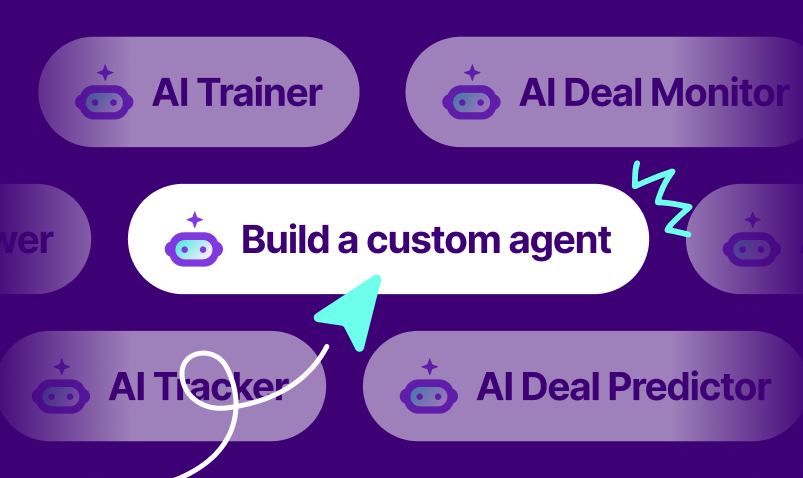
A model, a few prompts, and some connected apps can quickly produce a working agent. But building the right agents for distinct revenue workflows, then governing and operationalizing them across a larger organization, is what determines whether they deliver ROI at scale.
An agent needs the right signals for its task, connected to the right account, opportunity, and moment in the sales process. Teams also need to manage what an agent can access and do, how much it costs to run, and where its output leads. Without those pieces, agents struggle to deliver meaningful business outcomes. The result is increased operational risk, limited adoption, and unclear impact on sales productivity and revenue.
Gong Agent Builder helps revenue teams automatically build custom agents that turn revenue signals into revenue action. As part of Gong Revenue AI, it provides teams with the context, execution, and action their revenue workflows need.
Here’s one example of what that can look like.
Turn interest in a new product into a timely sales motion
Imagine a buyer expresses interest in a product they don’t currently use. A custom agent assesses account activity in real time to identify both product interest and timeline. Once triggered, the agent drafts outreach based on the buyer’s stated interest and timing, sends a Slack message to the rep, and creates a task for review. The rep gets the context and a next step at a timeline that’s relevant to the buyer.
If that signal stayed buried in a conversation, the team may have missed a chance to create a qualified opportunity. Instead, with their agent, they can track whether those signals lead to new opportunities and pipeline, to ensure potential whitespace doesn’t slip through the cracks.
Gong customer Brian Seitz, Director of Sales Enablement at Riskonnect Inc., explained how they built their own agent to improve their sales process:
“We built an agent to connect what our buyers are telling us with our broader solution portfolio, helping our sellers see not only what’s already been discussed but also where there may be additional needs or signals pointing to another offering. That allows us to expand the conversation beyond the initial solution, uncover opportunities we might otherwise have missed, and ultimately deliver more value to the customer.” - Bryan Seitz, Director of Sales Enablement, Riskonnect, Inc
Building this workflow in Gong brings three advantages: agents can reason over connected revenue context, run with governed and cost-aware execution, and put their output where revenue teams can act on it.
Make better revenue decisions with connected deal context
A model can reason over the information it receives. But someone still has to supply and maintain the relationships between customer interactions, people, accounts, opportunities, and outcomes. Without those connections, an agent can miss a risk even when the relevant signals exist.
Consider a deal where one call sounds positive, but another reveals that a competitor is offering a price 30 percent lower. An agent that only reads the latest call may miss that pressure. The Gong Revenue Graph connects interaction signals to the accounts, opportunities, and revenue processes they describe, helping an agent relate the competitive signal to the opportunity and its stage.
Teams can add their own expertise and supporting context, too. Reusable skills help agents follow specialized instructions across workflows. Agent files provide specific documents as execution context. And Model Context Protocol (MCP) can extend Skills and agents with permitted information from connected systems. Together, these capabilities help teams give each agent the revenue context and expertise relevant to its task.
Better context raises a new question, though. As agents multiply, how does your team keep them governed and cost-efficient?
Scale agents with governed, cost-aware execution
A generic model or agent builder doesn't decide what revenue data to process or what actions an agent can take. It also doesn't decide when a person should review its work. Your team has to design and manage that.
Without this oversight, every new workflow can mean more setup and more spend, which makes it harder to scale agents with confidence.
The Gong Revenue Harness runs agents with governed access, guardrails, human review, and performance and cost optimizations. You set permissions for what each agent can access, define the conditions under which it operates, and decide where a person stays in the loop. This ensures that your agents operate only within parameters you set.
The Gong Revenue Harness also optimizes how agents do the work. When an agent updates account business goals, an incremental update can process only what changed. It skips a full refresh when one isn't needed, reducing unnecessary computation and costs during the workflow.
Skills help that efficiency carry across your agent portfolio. A Skill defines how specialized work should be performed and which capabilities an agent can invoke. Your team defines that expertise once and applies it across agents, which reduces repeated setup as you create more of them.
For RevOps, this means the same process can run consistently across reps, accounts, and segments. Leaders get more consistent execution, and AI investment becomes easier to connect to revenue outcomes.
Even with governed, efficient execution, one gap remains. The output has to lead somewhere.
Turn agent output into action where your teams already work
An accurate answer only helps if someone acts on it. When agents sit outside the systems that revenue teams use to manage their work, follow-through gets harder.
People have to review the result, move it elsewhere, and decide what comes next. Those handoffs slow down follow-through and leave useful output sitting apart from the work it was meant to improve.
Agents built with Agent Builder work alongside Gong Applications, where your teams already manage that work. Depending on how you configure an agent and what it's permitted to do, it can take actions like:
- Sending a Slack message or email
- Updating CRM fields
- Generating a brief
- Enriching a contact
- Starting a Flow
- Acting in connected systems
MCP extends that reach. With MCP, your team can extend Skills and agents with permitted information and actions from external systems. Agents work with the rest of your stack, within the access you allow.
Picture an agent that flags competitive risk on a key opportunity. It can generate a risk brief for the rep to review within the same workflow they manage the account in. A trigger can also start the next Flow or update CRM, shortening the distance between an insight and the action that moves the deal forward.
Move from agent experiments to revenue execution
With Agent Builder, your team can build agents and workflows specific to your business. You don't have to rebuild the revenue context, execution controls, and path to action that production agents need. With Gong Revenue AI, those agents draw on the Gong Revenue Graph, run on the Gong Revenue Harness, and act through Gong Applications.
The result is more time for customer work, more consistent execution, and a clearer path from AI investment to revenue outcomes.
Check out Agent Builder below or book a demo today.
VP, Product @ Gong
Win more with Gong
Loading form...
Discover more from Gong
Check out the latest product information, executive insights, and selling tips and tricks, all on the Gong blog.